Chemical peel treatment in Hyderabad is one of the most requested skin procedures for acne marks, pigmentation, dull skin and uneven texture. But the idea behind it is thousands of years old. This guide covers the history of chemical peels, the TCA peel, yellow peel and glycolic peel used today, what affects chemical peel cost in Hyderabad, and answers to the questions patients ask us most at our chemical peel clinic in Gachibowli.
What is a chemical peel?
A chemical peel is a skin treatment in which a doctor applies a controlled acid solution to remove the outer layers of skin, encouraging smoother, brighter and more even skin to form. Peels are graded as light, medium or deep depending on the acid and how far it works into the skin.
What is chemical peel treatment in practice? It is a planned course: a skin assessment, the choice of peel, one or more sessions, and aftercare. A chemical skin peel is not a one-size product, which is why the same “chemical face peel” can mean very different things at different clinics.
In this guide
- Ancient origins of chemical peels
- The 1800s: peeling becomes science
- The 1900s: phenol, TCA and Jessner’s solution
- 1970s to today: the glycolic peel era
- Chemical peel types: TCA, yellow and glycolic
- Chemical peels for acne scars, pigmentation and ageing
- How the chemical peel procedure works
- Chemical peel treatment in Hyderabad
- Chemical peel cost in Hyderabad
- Chemical peel FAQs
Ancient origins: sour milk, wine and fruit acids
The first chemical face peel was not made in a laboratory. Ancient Egyptian women are widely reported to have used sour milk, which contains lactic acid, along with alabaster, fruit acids and wine-based preparations to smooth and brighten their skin. Stories of Cleopatra bathing in milk come from this tradition.
Similar ideas appear in other cultures. Greek and Roman writers describe skin preparations that used wine and fruit-based ingredients. In India, traditional beauty practices have long relied on curd, lemon and other naturally acidic ingredients to brighten the skin.
None of this was a controlled chemical peel treatment, and the strength of these home remedies was impossible to measure. But the principle was the one dermatologists use today: a mild acid loosens dead surface skin and reveals a fresher layer underneath.
The 1800s: dermatology turns peeling into science
Peeling became a medical subject in the late 19th century, as dermatology emerged as its own specialty in Europe. In 1882, the Hamburg dermatologist Paul Gerson Unna described how salicylic acid, resorcinol, phenol and trichloroacetic acid (TCA) affect the skin. His work laid the foundation for the peels used today.
At this stage, peeling was mainly used for freckles, pigmentation and scarring. The formulas were harsh by modern standards, and results depended heavily on the doctor’s skill. For a detailed academic account, see A history of chemical peeling by Brody, Monheit, Resnik and Alt (Dermatologic Surgery, 2000).
The 1900s: phenol, TCA and Jessner’s solution
The 20th century is when the chemical peel procedure became a recognised clinical treatment. In 1903, the dermatologist George Miller MacKee used phenol to treat acne scars, one of the first documented uses of a peel for that purpose.
In 1961, the Baker-Gordon phenol formula became the standard for deep peels, and TCA was refined as a peeling agent in the same era. Jessner’s solution, a blend of resorcinol, salicylic acid and lactic acid, gave doctors a way to deliver a lighter, more controlled peel.
In 1989, Monheit combined Jessner’s solution with TCA, creating a medium-depth peel with more predictable results. The TCA chemical peel became the workhorse of medium-depth peeling and remains popular today.
| Year | Milestone in the history of chemical peels |
|---|---|
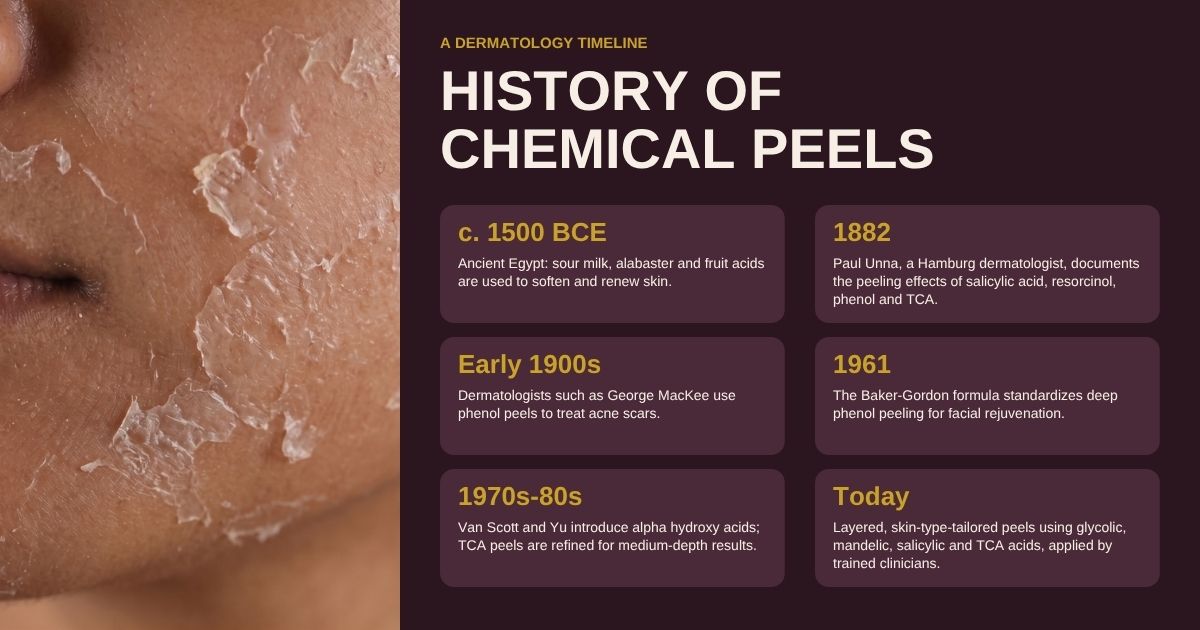
| c. 1500 BCE | Ancient Egypt: sour milk, alabaster and fruit acids used to soften skin |
| 1882 | Unna documents salicylic acid, resorcinol, phenol and TCA as peeling agents |
| 1903 | MacKee uses phenol peels for acne scars |
| 1961 | Baker-Gordon formula standardises deep phenol peeling |
| 1970s–80s | Van Scott and Yu introduce alpha hydroxy acids; TCA peels refined |
| 1989 | Monheit’s Jessner plus TCA combination peel |
| Today | Skin-type-tailored glycolic, mandelic, salicylic, yellow and TCA peels |
1970s to today: gentler acids and the glycolic peel
The biggest shift in the history of chemical peels came in the 1970s, when Eugene Van Scott and Ruey Yu published research on alpha hydroxy acids (AHAs). They showed these fruit-derived acids could improve the skin surface with far less risk than phenol.
By the 1990s, the glycolic acid chemical peel had become a mainstream clinic option for acne marks, dull skin and uneven texture. Its appeal was clear: little downtime, predictable results and an easy fit into a busy schedule. The glycolic chemical peel, sometimes sold as a glycopeel, remains one of the most requested peels today.
More recently, retinoid-based formulas such as the yellow peel have become popular, especially for pigmentation and tired-looking skin.
Chemical peel types today: TCA, yellow and glycolic
Modern chemical peel treatment is grouped by depth. Light peels act on the top layer of skin, medium peels reach deeper, and deep peels are now rare and done only under close medical supervision. The American Academy of Dermatology’s chemical peels overview explains the same three depths.
| Peel | Typical depth | Commonly used for |
|---|---|---|
| Glycolic peel | Light | Dull skin, mild acne marks, uneven texture |
| Yellow peel | Light to medium | Pigmentation, melasma, tired-looking skin |
| TCA peel | Medium (strength varies) | Pigmentation, acne scars, fine lines |
| Deep (phenol) peel | Deep | Rarely used today; strict medical supervision |
TCA peel (trichloroacetic acid peel)
A TCA peel is a medium-depth peel usually chosen for stubborn pigmentation, acne scars and fine lines. Strength is adjusted to the skin, and a TCA body peel can also be used on areas such as the back or arms. Downtime is longer than with a light peel.
Yellow peel treatment
Yellow peel treatment uses a retinoid-based formula and gets its name from the yellow tint it leaves on the skin. A yellow peel for the face is often discussed for pigmentation, melasma and acne marks, and yellow peel post care focuses on sun protection and not picking peeling skin.
Glycolic peel
A glycolic peel is a light alpha hydroxy acid peel suited to dull skin, mild acne marks and texture. It is often used as a starting peel or in a course of sessions with little downtime.
TCA peel vs glycolic peel: which is right for your skin? It depends on your concern, skin type and how much downtime you can accept, which is why a skin assessment always comes first.
Chemical peels for acne scars, pigmentation and ageing
Most people search by problem first and treatment second. Chemical peels are commonly considered for:
- Acne and acne scars: glycolic acid for acne scars, TCA peels and yellow peel for acne scars are all used for marks and texture, depending on depth.
- Pigmentation and melasma: yellow peel for melasma and other peels may be suggested, depending on skin type.
- Glowing skin: a light chemical peel for glowing skin removes dull surface cells and can refresh skin tone.
- Wrinkles and skin rejuvenation: a chemical peel for wrinkles or an anti ageing chemical peel can soften fine lines, often as part of a wider anti-ageing plan.
- Uneven skin texture: repeated light peels can smooth rough or uneven skin. DermNet lists the common uses and risks of each peel type.
Some patients combine peels with other treatments in our combination treatment packages. See real results on our before and after page. Results vary by skin type and condition, and a skin assessment decides the right peel.
How the chemical peel procedure works
Chemical peel how it works, step by step:
- Skin assessment: your doctor checks skin type, concern, history and medicines.
- Preparation: the skin is cleansed and sensitive areas are protected.
- Application: the peel is applied for a set time, then neutralised or removed.
- Aftercare: moisturiser, strict sun protection and no picking or scrubbing.
Chemical peel treatment in Hyderabad
If you are searching for a chemical peel near me in Gachibowli, or wondering where can I get a chemical peel done in Hyderabad, start with a consultation. At Rida Radiance Skin & Hair Clinic, our doctors assess your skin before recommending a peel, so you get a plan built for you rather than a standard package.
Our chemical peel in Gachibowli is planned around your skin, not a fixed menu. Every skin peel treatment in Gachibowli starts with an assessment, and the peel, strength and number of sessions are chosen after that.
Yellow peel, TCA peel and glycolic peel in Hyderabad
We offer yellow peel treatment in Hyderabad for pigmentation and tired-looking skin, TCA peel in Hyderabad for deeper marks and acne scars, and glycolic peel in Hyderabad as a light option with little downtime. Your doctor explains why one suits you better than another.
Chemical peel for acne scars in Hyderabad
A chemical peel for acne scars in Hyderabad is usually a course of glycolic or TCA peels, sometimes combined with other treatments. Active acne is calmed first, and results depend on the type and depth of the scars.
Chemical peel for pigmentation in Hyderabad
Sun exposure in Hyderabad’s climate makes pigmentation a common concern. A chemical peel for pigmentation in Hyderabad, often a yellow peel or a light series, works best alongside daily sunscreen and good aftercare.
Chemical peel for glowing skin in Hyderabad
If your goal is fresher, brighter skin before an event or as maintenance, a light chemical peel for glowing skin in Hyderabad can be a low-downtime option. Many patients book a short series ahead of weddings and celebrations.
Chemical peel in Kondapur, Madhapur, Hitech City, Financial District and Manikonda
Searching for a chemical peel near me from a nearby area? Our Gachibowli clinic serves patients looking for a chemical peel in Kondapur, a chemical peel in Madhapur, a chemical peel in Hitech City, a chemical peel in the Financial District and a chemical peel in Manikonda, all a short drive away. Call 9676927700 to book.
How to choose the best chemical peel clinic in Hyderabad
- Ask who will perform your peel and their qualifications. A dermatologist chemical peel in Hyderabad, or one done under a doctor’s supervision, is safer than a salon peel.
- Expect a skin assessment before any peel is chosen, as recommended in the IADVL standard guidelines of care for chemical peels (Indian Journal of Dermatology, Venereology and Leprology).
- Ask about downtime, number of sessions and aftercare in advance.
- Be wary of choosing on price alone: a cheap chemical peel near me can cost more if it causes irritation or pigmentation.
Chemical peel cost in Hyderabad
How much is a chemical peel? Chemical peel cost in Hyderabad, and chemical peeling charges in Hyderabad, depend on skin type, peel type, the number of sessions and your doctor’s assessment. There is no single fixed price.
| Cost factor | How it affects price |
|---|---|
| Peel depth | Light chemical peel cost is lower than medium; deep chemical peel cost is highest |
| Peel type | Glycolic acid peel cost, yellow peel cost in Hyderabad and TCA peel pricing differ |
| Concern | A chemical peel for acne cost or price can differ from a pigmentation plan |
| Sessions | Most concerns need a course, not one visit |
| Area treated | Face, neck or a TCA body peel are priced differently |
For indicative per-session prices, see our aesthetic treatment prices in Hyderabad guide. For a personalised quote, including dermatologist chemical peel cost, call us or view our chemical peel treatment page. Like yellow peel price in India generally, our pricing is set after your skin assessment.
Chemical peel FAQs
How often should chemical peels be done?
It depends on the peel. Light peels such as glycolic are often repeated every few weeks, while medium peels need longer gaps. Your doctor sets the schedule after assessing your skin.
How does a chemical peel work?
A chemical peel applies a controlled acid to the skin, which loosens and removes the outer layers. New skin forms underneath, which can look smoother, brighter and more even.
How much is a chemical peel in Hyderabad?
Chemical peel cost in Hyderabad depends on skin type, peel type, number of sessions and your skin assessment. Contact the clinic for a personalised quote.
Where can I get a chemical peel done in Hyderabad?
Choose a clinic where a doctor assesses your skin first. Rida Radiance Skin & Hair Clinic in Gachibowli offers consultation-based chemical peel treatment in Hyderabad.
Is a glycolic acid peel safe during pregnancy?
Pregnancy changes which skin treatments are suitable. Tell your doctor if you are pregnant or planning to be, and do not book any peel without that conversation.
What are glycolic acid peel side effects?
Mild redness, dryness, stinging or flaking can occur after a glycolic acid peel. Your doctor will explain what to expect for your skin type.
What is yellow peel post care?
Yellow peel post care usually means gentle cleansing, moisturiser, strict sun protection and not picking at peeling skin. Follow your doctor’s instructions.
What is the downtime after a chemical peel?
Light peels usually cause mild redness or flaking, while medium peels such as TCA can cause visible peeling for several days.
How many chemical peel sessions are needed?
Many concerns, such as acne marks or pigmentation, are treated with a series of sessions. The number depends on your skin and goals.
What is the right age for a chemical peel?
Chemical peels are generally considered for adults. The right time depends on your skin concern, and your doctor will advise after an assessment.
Are chemical peels worth it?
Many people find peels helpful for dull skin, pigmentation and texture, but results vary by skin type and condition. A consultation helps you decide.
Chemical peel vs hydrafacial: what is the difference?
A hydrafacial cleanses and hydrates the skin. A chemical peel uses acids to work on the skin’s surface layers, so it targets pigmentation and texture more directly.
Where can I get a chemical peel in Gachibowli?
Rida Radiance Skin & Hair Clinic in Gachibowli offers consultation-based chemical peel treatment, including yellow, TCA and glycolic peels.
Do you see patients from Kondapur, Madhapur and Hitech City?
Yes. Our Gachibowli clinic is a short drive from Kondapur, Madhapur, Hitech City, Financial District and Manikonda.
What are chemical peeling charges in Hyderabad?
Chemical peeling charges in Hyderabad depend on the peel type, depth, number of sessions and your skin assessment. Yellow peel cost in Hyderabad and TCA peel pricing also differ.
From Cleopatra’s milk baths to your skin consultation
The history of chemical peels runs from sour milk rituals in ancient Egypt to carefully chosen TCA, yellow and glycolic peels. The goal has not changed: healthier, fresher-looking skin. What has changed is the science, the safety and the personalisation.
Looking for chemical peel treatment in Hyderabad? Book a skin consultation at Rida Radiance in Gachibowli and we will recommend the peel that suits your skin. Call 9676927700 or contact us online.
Related reading
- The history of Botox treatment
- The history of dermal fillers
- Skin boosters in Gachibowli
- Choosing a skin and hair clinic in Gachibowli
Results vary by skin type and condition. A skin assessment decides the right peel for you.