Quick answer: Non-surgical rhinoplasty in Hyderabad typically costs ₹15,000 to ₹40,000 for a single session using 0.5–1 ml of hyaluronic acid filler, with most straightforward cases landing around ₹25,000–₹30,000. The procedure takes about 20–30 minutes, results are visible the same day, and they last roughly 9–15 months depending on the filler used and your anatomy. It can smooth a dorsal hump, lift a drooping tip and straighten a mildly crooked profile — but it cannot make a large nose smaller.
Want to compare nose fillers with other treatments? Our Hyderabad aesthetic treatment price guide lists Botox, filler, hair and skin prices side by side.
Non-surgical rhinoplasty is part of a wider shift towards “tweakments” in the city — read more on dermal filler trends in Hyderabad and the treatments patients are choosing in 2026.
If you have spent any time looking at your profile photos and wishing the bridge were straighter or the tip a little lifted, you have probably also discovered that surgical rhinoplasty means general anaesthesia, a week of splints and swelling, and a recovery that shows up in every photograph for a month. That gap — between wanting a change and not wanting an operation — is exactly what non-surgical rhinoplasty fills.
This guide covers what the procedure actually does, what it genuinely costs in Hyderabad in 2026, who is a good candidate, and — the part most articles skip — where the real risks sit and what a safe clinic does about them.
What is non-surgical rhinoplasty?
Non-surgical rhinoplasty (also called a liquid nose job, filler rhinoplasty, or a 15-minute nose job) reshapes the nose by placing small, precise amounts of hyaluronic acid dermal filler along the bridge, the radix (the dip between the eyes), and the tip.
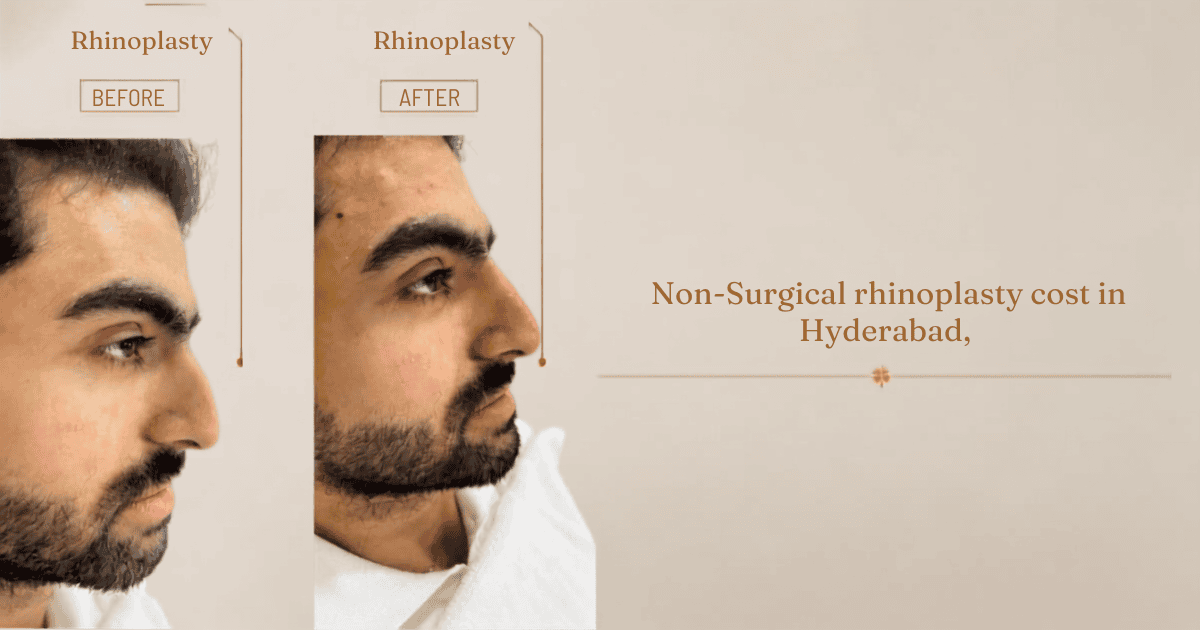
The counter-intuitive part: it works by adding volume, not removing it. A dorsal hump does not get filed down — filler is placed above and below the hump so the profile reads as one continuous straight line. A drooping tip is not trimmed — a small deposit at the columella base rotates it upward. The nose becomes marginally larger in absolute terms, but it looks straighter, more defined, and better proportioned to the rest of the face.
That is the whole trick, and understanding it tells you immediately what the treatment can and cannot do. The same family of hyaluronic acid dermal fillers used for cheeks, chin and jawline is used here — just placed with far greater precision and in far smaller amounts.
What non-surgical rhinoplasty can and cannot fix
| Works well for | Needs surgery instead |
|---|---|
| Smoothing a small-to-moderate dorsal hump | A large, prominent bony hump |
| Building up a flat or low bridge | Reducing the overall size of the nose |
| Lifting a slightly drooping or under-projected tip | Narrowing wide nostrils or a bulbous tip |
| Straightening a mildly deviated profile | Significant deviation or a deviated septum |
| Correcting minor asymmetries and small dents | Breathing problems or functional obstruction |
| Refining small irregularities after a previous surgical rhinoplasty | Structural collapse or major revision work |
If your main complaint is “my nose is too big,” fillers are the wrong tool and any clinic that tells you otherwise is selling rather than assessing. Surgical rhinoplasty remains the definitive option for genuine reduction and structural change.
Non-surgical rhinoplasty cost in Hyderabad
Pricing in Hyderabad is driven almost entirely by two variables: how much filler is used, and which brand it is. Everything else — the consultation, numbing cream, the injection itself — is comparatively minor.
| What you are paying for | Typical range in Hyderabad |
|---|---|
| Consultation and assessment | ₹500 – ₹1,500 (often adjusted against treatment) |
| Single session, 0.5 ml filler (subtle correction) | ₹15,000 – ₹22,000 |
| Single session, 1 ml filler (most common) | ₹25,000 – ₹40,000 |
| Complex or two-syringe cases (bridge + tip) | ₹40,000 – ₹65,000 |
| Top-up at 9–15 months | Usually 50–70% of the original session |
| Dissolving with hyaluronidase, if ever needed | ₹5,000 – ₹10,000 |
What moves the price up or down:
- Filler brand and grade. A high-cohesivity, high-G-prime filler designed to hold a sharp edge on the nasal dorsum costs considerably more per millilitre than a soft filler meant for lips or cheeks. This is not a place to shop on price — a soft filler on the bridge spreads sideways and gives you a wider nose, which is the opposite of the goal.
- Volume required. Most noses need 0.5–1 ml. Genuinely needing more than 1.5 ml in one sitting is a sign the case may be better served surgically.
- Injector experience. The nose is the single highest-risk area on the face for filler. Experienced injectors charge more, and in this specific procedure that premium is the point.
- Whether ultrasound guidance is used. Some clinics now map the nasal vessels with high-frequency ultrasound before injecting, which adds cost and adds safety.
- Location. Clinics in Jubilee Hills and Banjara Hills generally price above those in Gachibowli, Madhapur and HITEC City for the same work — the same pattern we mapped out in our Botox cost in Hyderabad guide.
For context, surgical rhinoplasty in Hyderabad typically runs ₹80,000 to ₹2,50,000 or more once surgeon fees, anaesthesia and hospital charges are included — so filler rhinoplasty sits at roughly a fifth to a third of the cost, with the important caveat that it is temporary.
Prices above reflect the Hyderabad market in 2026 and are indicative. Your exact cost depends on the assessment — ask any clinic for a written quote that names the filler brand and the volume before you agree to anything.
How the procedure works, step by step
- Assessment (15–20 minutes). Your nose is examined in profile, three-quarter and front view, and in relation to your forehead, chin and facial thirds. A nose that looks large is sometimes a chin that is under-projected — a good consultation catches this. Any history of previous rhinoplasty, filler, or permanent injectables must be disclosed here.
- Numbing (20–30 minutes). Topical anaesthetic cream is applied. Most fillers used also contain lidocaine.
- Injection (10–20 minutes). Filler is placed deep, against the bone and cartilage in the relatively avascular plane, in very small aliquots. The injector works slowly, in the midline where possible, with constant assessment between deposits.
- Shaping and review. The filler is moulded, and you see the result in a mirror before you leave.
- Aftercare. You walk out the same day. Mild swelling or a little bruising is common for 2–4 days.
Total chair time is usually under an hour, most of which is waiting for numbing cream to work.
Recovery and aftercare
- Do not press, massage or rub the nose for two weeks unless specifically instructed to.
- No glasses or sunglasses resting on the bridge for two weeks — the weight can displace fresh filler.
- Skip the gym, sauna and steam for 48 hours.
- Avoid facials, threading over the nose, and any facial massage for two weeks.
- Sleep on your back for the first two or three nights.
- Alcohol and blood-thinning supplements (fish oil, high-dose vitamin E, ginkgo) increase bruising — pause them for a few days before and after if your doctor agrees.
Final settled result is usually visible at 2–3 weeks once swelling resolves. A short review appointment at that point is worth booking.
How long do the results last?
Hyaluronic acid filler in the nose generally lasts 9 to 15 months, and often a little longer than the same filler placed in mobile areas like the lips — the nose barely moves, so the filler degrades more slowly.
Longevity depends on the filler’s cross-linking, the volume placed, your metabolism, and your age. Many people find their second treatment lasts longer than the first.
Two things worth being clear-eyed about. First, this is a maintenance treatment, not a one-time fix — budget for a top-up roughly once a year. Second, that impermanence is genuinely an advantage: if you dislike the result, hyaluronic acid filler can be dissolved with hyaluronidase within a day or two and your nose returns to baseline. Surgery offers no such undo button.
Risks, and how a good clinic manages them
This section matters more than any other on this page, and most marketing pages for this treatment skate over it.
The common side effects are minor and self-limiting: swelling, redness, tenderness, small bruises, and occasionally a temporary headache. These settle within days.
The serious risk is vascular occlusion — filler entering or compressing one of the nasal arteries. It is rare, but the nose and the area between the eyebrows are recognised as the highest-risk zones on the face for it, because the nasal vessels connect back to the ophthalmic artery. If it happens and is not managed immediately, the consequences range from skin necrosis over the nose to, in the rarest cases, permanent vision loss.
You cannot reduce this risk to zero, but a competent clinic reduces it substantially, and you are entitled to ask how. What to look for:
- A doctor who knows the nasal vascular anatomy and injects in the deep, relatively avascular plane against the bone and cartilage — not superficially.
- Slow injection, small volumes, low pressure. Speed is the enemy here.
- Hyaluronidase on the premises — the enzyme that dissolves hyaluronic acid filler — with a written emergency protocol. Ask to be told it is there. A clinic that has to send someone out for it is a clinic to walk out of.
- Hyaluronic acid filler only. Permanent and semi-permanent fillers in the nose cannot be reversed and are associated with far worse long-term complications. Nothing that cannot be dissolved belongs in a nose.
- Honest refusal. A good injector will decline cases that need surgery, and will be cautious in anyone who has had a previous surgical rhinoplasty — scarred tissue has unpredictable blood supply, and a waiting period after surgery is usually advised.
You should not have this treatment if you are pregnant or breastfeeding, have an active infection or inflammation on or near the nose, have a known allergy to hyaluronic acid or lidocaine, have a bleeding disorder, or have had permanent filler of unknown type injected into the nose previously.
Non-surgical vs surgical rhinoplasty
| Filler rhinoplasty | Surgical rhinoplasty | |
|---|---|---|
| Time taken | 20–30 minutes | 2–4 hours in theatre |
| Anaesthesia | Topical numbing cream | General anaesthesia |
| Downtime | None to 2 days | 1–2 weeks visible, months to fully settle |
| Results visible | Immediately | 6–12 months for final shape |
| Duration | 9–15 months | Permanent |
| Reversible | Yes, with hyaluronidase | No |
| Can reduce nose size | No | Yes |
| Fixes breathing issues | No | Yes |
| Cost in Hyderabad | ₹15,000 – ₹40,000 | ₹80,000 – ₹2,50,000+ |
A useful way to think about it: filler rhinoplasty is a low-commitment way to find out whether a straighter profile actually suits your face. A meaningful number of people try it, love it, and simply maintain it. Others use it as a preview before committing to surgery. Both are reasonable. A straighter nose is only half of the side profile, though — if fullness under the chin softens your jawline, double chin treatment is often the natural companion procedure.
Is it worth it?
For the right nose, it is one of the highest-satisfaction procedures in aesthetic medicine — a fifteen-minute appointment that changes a feature people have quietly disliked for twenty years. For the wrong nose, it is money spent making a large nose slightly larger.
The single most important decision you make is not which filler or which price — it is who holds the syringe. In an area where the anatomy is this unforgiving, experience is not a premium feature. It is the product.
Non-surgical rhinoplasty in Hyderabad at Rida Radiance
At Rida Radiance Skin & Hair Clinic in Gachibowli, nose filler is performed by an MBBS-qualified aesthetic physician using reversible hyaluronic acid fillers only, with hyaluronidase and a written emergency protocol on site. Consultations include an honest assessment of whether fillers are the right answer for your nose — and a clear recommendation for surgical referral when they are not.
Full treatment details, including what the session involves and our before-and-after approach, are on our non-surgical rhinoplasty treatment page. We see patients from across Hyderabad including Gachibowli, Madhapur, HITEC City, Kondapur, Jubilee Hills and Banjara Hills.
Book a nose assessment consultation →
Frequently asked questions
Is non-surgical rhinoplasty painful?
Most people describe it as mild pressure rather than pain. Topical numbing cream is applied beforehand and the fillers used contain lidocaine. The tip is usually the most sensitive point, and it takes seconds.
How much does non-surgical rhinoplasty cost in Hyderabad?
Between ₹15,000 and ₹40,000, depending on complexity and the filler used. A typical single session with 1 ml of hyaluronic acid filler lands around ₹25,000–₹30,000; simpler corrections using 0.5 ml start lower, and complex cases needing two syringes can reach ₹65,000. At Rida Radiance the final quote is given after consultation.
How long does it last?
Usually 9 to 15 months. The nose is a low-movement area, so filler placed there often outlasts the same filler in the lips or cheeks.
Can nose fillers make my nose smaller?
No. Filler adds volume. It can make a nose look straighter, more defined and better proportioned, but if you want genuine reduction you need surgical rhinoplasty.
Can it be reversed if I don’t like it?
Yes, provided hyaluronic acid filler was used. An injection of hyaluronidase dissolves it within a day or two and returns your nose to baseline. This is one of the strongest arguments for refusing any permanent filler in the nose.
Is there any downtime?
Effectively none. You can return to work the same day. Mild swelling or a small bruise may be visible for two to four days.
Can I have it after a surgical rhinoplasty?
Sometimes — filler is often used to refine small irregularities after surgery. But scarred tissue has an unpredictable blood supply, which raises the risk, and a waiting period after your operation is usually advised. This needs a careful, individual assessment.
Will it look obvious?
Done well, no. The result should read as a better version of your own nose, not a different one. Over-filling — usually from injecting too much in one session — is what produces an unnatural, widened bridge.
How soon can I see the results?
Immediately, on the day. The final settled result appears at two to three weeks once swelling resolves.
How many sessions will I need?
One in most cases. Occasionally a small refinement is added at the two-to-three-week review. After that it is a top-up roughly once a year.